
- 6,800 m² facility in Hengli Town, Dongguan — founded 2005, 100+ people.
- 100+ production machines — milling, turning, mill-turn, grinding; 20+ inspection instruments.
- Deep capacity — redundancy that keeps a delivery date reliable when the unexpected happens.
- Registration No. 91441900MA4UWT6X39 — legal name Dongguan Zhuohang Ltd
Where is the factory, and why does location matter for schedule?
The facility sits at No. 8, Shuibian Songyuan Road, Hengli Town, Dongguan, Guangdong, China 523470 — in a dense precision-machining supply region. Location matters for schedule because it determines access to raw material and to secondary-process partners. A factory in a machining cluster can re-source bar stock and finish surface treatments faster than one isolated from the supply base, which shortens the supply side of your lead time.
How does the machine count affect your delivery date?
Machine count is the difference between a date that survives a bad week and one that does not. With 100+ production machines, a job slots in without displacing others, and a machine failure or quality hold does not idle your part — there is another spindle to absorb it. Thin capacity is the opposite: your date competes with every other customer for the same few machines, and any hiccup pushes it back.
| Area | Count | What it means for schedule |
|---|---|---|
| CNC milling (3/4/5-axis) | 50+ / 20+ / 20+ | Jobs slot in without displacing others |
| CNC turning | 25+ lathes | Turning work spreads across many spindles |
| Precision grinding | 7+ grinders | Finish operations keep their own capacity |
| Inspection instruments | 20+ | Verification never becomes the bottleneck |
How many machines and people run the facility?
The facility runs 100+ production machines — milling, turning, mill-turn, and grinding — plus 20+ inspection instruments, staffed by 100+ people. Workforce depth matters for schedule stability: 80%+ are skilled technicians, and 60% hold 5–10 years on the job. A senior workforce holds a process in control longer, which means fewer surprise corrections and fewer schedule slips. The founder's 28 years of industry experience sits behind the operation.
What certifications does the factory hold?

Certification matters for schedule because a documented, controlled process produces predictable output. The factory holds three, with numbers you can verify.
| Standard | Certificate number | Scope |
|---|---|---|
| ISO 9001:2015 | 116024/A/0001/UK/En | Machining of metal parts |
| IATF 16949:2016 | 131941/A/0001/SM/En | Manufacture of CNC metal machining parts (excludes product design, Clause 8.3) |
| ISO 14001:2015 | 116024/B/0001/UK/En | Environmental management related to machining of metal parts |
How does the factory keep a quality hold from delaying your job?
A quality hold is a schedule event, and the factory's job is to keep it a small one. Batch-level traceability lets it quarantine only the affected lot while the rest of the schedule keeps moving, and parallel inspection capacity means verification does not become the bottleneck. A factory that cannot isolate a hold stops the whole line; this one isolates to a lot.
How does the workforce's experience translate into reliable dates?
Machines do not hold tolerance; the people who set and run them do. A workforce where 80%+ are skilled technicians and 60% have 5–10 years on the job produces fewer setups that need re-doing and fewer parts that need re-running. That stability is what turns a quoted lead time into a kept one — the difference between a schedule written on paper and one that survives the shop floor.
Can you verify the factory before committing to a date?
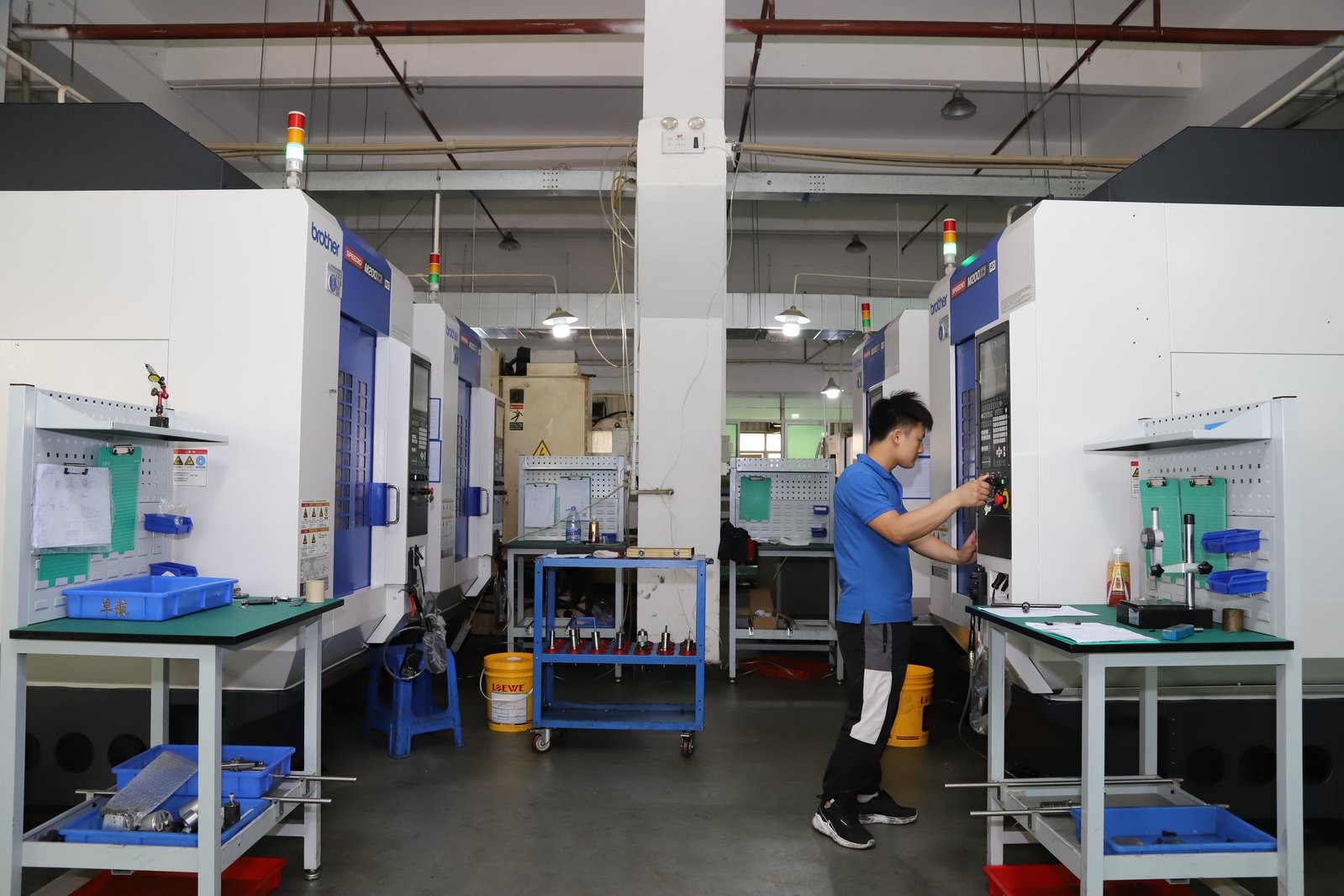
Yes, and you should. A factory visit is welcome, and a live video walk of the floor and inspection room is available for buyers who cannot travel. The purpose is to verify the machines and the capacity yourself, because a delivery date is only as reliable as the floor that backs it. A factory that shows its floor and its machine list is one you can plan a production line around.
Honest scope note: IATF 16949 excludes product design under Clause 8.3 — this is a build-to-print factory, which keeps the schedule unambiguous about who owns what.
How does capacity planning work across a reorder?
Capacity planning distinguishes a first order from a reorder. The first order carries setup and first-article time; the reorder carries only run time, because the setup is already proven and documented. That is why reorders ship on a shorter clock, and why if you front-load the first article early in the program, you buy a fast, predictable reorder lead time for the life of the part.
How do machine brands translate into schedule stability?
Machine brand is a proxy for two schedule properties that matter more than the name on the casting: thermal stability and repeatability. A spindle and bed that hold their geometry as they warm up produce parts that stay in tolerance through a long run, which means fewer mid-run corrections and fewer re-inspections. The shop runs Mazak, Brother, and TSUGAMI machining centers, plus Sodick and other grinding platforms; turning capacity includes Citizen and Star machines for high-precision lathe work.
The schedule effect is second-order but real. A machine that drifts forces the operator to stop, measure, offset, and re-run — each of which is a delay that a stable machine never generates. Depth of brand matters less than the behavior of the machine park as a whole: a floor full of machines that hold position through a shift is a floor where a quoted lead time survives until the last part clears inspection.
How does shift coverage and cross-training protect a date?
Capacity is not just machines; it is the people who can run them, and whether the floor can keep moving when one person is out. A workforce where 80%+ are skilled technicians and 60% hold 5–10 years on the job supports two things a schedule depends on: shift coverage, so work does not stop when a shift ends, and cross-training, so a machine does not idle when its usual operator is away.
The test is redundancy again, applied to people. A shop where one operator is the only person who can run the 5-axis cell has a single point of failure on the calendar. A shop where several people can set and run each cell — because the skills are documented and shared, not locked in one head — keeps a date through vacation, illness, and turnover. That is the workforce half of the same redundancy the machine count provides on the hardware side.
How does the factory plan and level its loading across the week?
Loading is planned, not discovered. The production schedule levels incoming orders against the machine park by process type — milling, turning, mill-turn, grinding — so that no single cell becomes the bottleneck while others sit idle. A bottleneck cell is where lead time is born: every job queued behind it inherits its wait. Leveling moves work to parallel capacity before a queue forms.
The planning input is the routing. Each order arrives with its process steps and its tier, and the scheduler places it against the cells that can run those steps. When one cell is full, the question is whether a parallel machine can absorb the work, which is exactly why depth of capacity, 50+ 3-axis mills and 25+ lathes, matters in practice. A floor that levels by routing keeps a single urgent order from silently displacing ten other committed dates.
What should you verify on a floor walk before trusting the capacity?
A floor walk is where a capacity claim becomes either a fact you saw or a story you heard. Five things to look for, and each maps to a schedule property:
- Machines actually running. A floor full of parked spindles is a floor whose capacity is idle for a reason; a floor where most spindles are cutting is one with real load and real throughput.
- Inspection room, not a shelf. Confirm the 20+ instruments are on benches and in use, not shown in a brochure — inspection capacity is what keeps verification off the critical path.
- Material and WIP flow. Raw stock staged at the machines and parts moving between operations means the routing is live, not a diagram.
- Tooling and fixture library. A maintained library means reorders and repeat parts re-use proven setup, which is what makes them fast.
- People at the machines. A skilled operator at each running cell is the difference between a machine count and a capacity that can actually be scheduled.
None of this requires you to travel. A live video walk of the floor and inspection room shows the same things, and a supplier that is willing to show them is one whose capacity claim you can verify rather than take on faith.
How do the plant's history and the founder's experience stabilize a schedule?
A schedule is only as reliable as the accumulated judgment behind it, and judgment comes from time on the floor. The plant was founded in 2005, and the founder brings 28 years of industry experience to the operation. That history matters for lead time in one specific way: a planner who has seen a given part family fail knows which routings need buffer and which do not, and quotes accordingly.
Experience is how an honest date gets made. An inexperienced estimator guesses at the step count and pads everywhere; an experienced one knows from memory how long a 5-axis setup really takes, where a surface-finish queue forms, and which tolerances slow the run. The result is a quote that is tight where it can be and honest where it must be — a date built from accumulated failure and correction, not from a spreadsheet template. For you, that is the difference between a number that looks good and a number that holds.
Put the history and the hardware together, and the capacity picture is complete: a floor of 100-plus machines for throughput, 20+ instruments for verification, a skilled and cross-trained workforce for coverage, and two decades of accumulated judgment for the quote itself. Each layer is a redundancy, and together they are why a delivery date from this floor is a plan you can build a production line around rather than a promise you have to babysit.
What this shop actually runs
If you ask for capability evidence, you deserve a specific answer. This facility operates 100+ CNC machines across 6,800 m2 in Dongguan, China, staffed by 100+ people. The machines, listed by category:
- 5-axis machining centres (10+) - Mazak VARIAXIS I-600 (510/910/510 mm travel, 12,000 rpm, 22 kW, 71.6 N·m, 30-tool BT40) and Mazak INTEGREX I-250H S (B-axis 0.0001°, 24 kW, 124 N·m, 38-tool HSK-A63). Run on compound-angle parts, single-setup multi-face prismatic work, and aerospace fittings where datum transfer loss is unacceptable.
- 3-axis / 4-axis machining centres (50+) - Brother SPEEDIO S500Z2N / S700Z2N (10,000 rpm, 14/21-tool ATC, 0.7 s tool-to-tool, Z-axis 2.2 G) and Mazak VCE-430A L / VCE-570C L (10,000 rpm, 118 N·m, 24-tool ATC). Run on prismatic parts, plates, brackets, housings.
- Swiss-type turning centres (10+) - Citizen Cincom A20-3F7 (Φ20 mm, 10,000 rpm), TSUGAMI B0206-III / B0205-III (Φ20 mm, 0.1 µm), STAR SR-32JII / SR-32J Type N (Φ32 mm, 8,000 rpm). Run on long, slender rotational parts at ±0.002 mm.
- CNC turning centres (20+) - HEADMAN T70M/1250 (720 mm swing, 117 mm bore, 3,000 rpm, BMT75 12-station turret). Run on shafts, bushings, flanges up to ±0.002 mm.
- Wire EDM (5+) - Sodick AQ535L (550/350/300 mm travel, ±20° taper, 800 kg workpiece). Run on hardened tool steel, internal splines, sharp internal corners that milling cannot reach.
- Inspection: Hexagon CMM + 20+ gauges - Hexagon CMM for coordinate measurement, plus vision system, profilometer, hardness tester, coating thickness gauge, XRF for material verification. The 10:1 rule (gauge 10x more accurate than the band) is applied to every feature.
- Machine highlights - VARIAXIS I-600: one-setup multi-face 5-axis + MAZA-CHECK auto-calibration; INTEGREX I-250H S: DONE-IN-ONE mill-turn, B-axis 0.0001° + Ai thermal shield; SPEEDIO S500Z2N / S700Z2N: Z-axis 2.2 G + 0.7 s ATC; Swiss-type: guide-bush switchable + 0.1 µm resolution.
Tolerance bands: ±0.003 mm milled, ±0.002 mm turned, ±0.002 mm ground or wire-cut. Capability indices: Ppk >= 1.67 at the initial study; Cpk >= 1.33 ongoing in production.
Certifications: ISO 9001:2015 (116024/A/0001/UK/En) · IATF 16949:2016 (131941/A/0001/SM/En, design clause 8.3 excluded) · ISO 14001:2015 (116024/B/0001/UK/En), held by Dongguan Zhuohang Ltd (USCC 91441900MA4UWT6X39, since 2005).
Service area: we supply Austria, Belgium, the Czech Republic, Denmark, France, Germany, Greece, Hungary, Ireland, Italy, the Netherlands, Spain, Sweden and the United Kingdom in Europe; Brazil, Canada, Mexico and the United States in the Americas; China, Israel, Japan, Singapore and Sri Lanka in Asia; Australia and New Zealand in Oceania; and South Africa in Africa, with worldwide delivery from China.
Contact: Felipe Iglesias, [email protected], +86 13126536955.
Verify the capacity behind your delivery date.
Send your drawing to [email protected] or call +86 13126536955, or request a live floor walk before you commit.
Frequently Asked Questions
Where is the factory located?
No. 8, Shuibian Songyuan Road, Hengli Town, Dongguan, Guangdong, China 523470. It is a 6,800 m² facility founded in 2005, with 100+ production machines and 20+ inspection instruments.
How does the machine count affect my delivery date?
Deep capacity means your job slots in without displacing others, and a machine failure or quality hold does not idle your part. The over a hundred machines provide the redundancy that keeps a date reliable when the unexpected happens.
What certifications does the factory hold?
ISO 9001:2015 (116024/A/0001/UK/En), IATF 16949:2016 (131941/A/0001/SM/En), and ISO 14001:2015 (116024/B/0001/UK/En). IATF 16949 excludes product design under Clause 8.3 — a build-to-print operation.
How many machines and people run the facility?
100+ production machines — milling, turning, mill-turn, and grinding — plus 20+ inspection instruments, staffed by 100+ people with 80%+ skilled technicians and 60% holding 5–10 years of experience.
Can I visit or verify the factory before ordering?
Yes. A factory visit is welcome, and a live video walk of the floor and inspection room is available for buyers who cannot travel. The purpose is to let you verify the machines and capacity yourself.
How does the factory keep a quality hold from delaying my job?
Batch-level traceability lets the factory quarantine only the affected lot while the rest of the schedule keeps moving, and parallel inspection capacity means verification does not become the bottleneck.
How does the founder's experience affect the delivery date?
The founder's 28 years of industry experience, over a plant founded in 2005, means the quote is built from accumulated judgment about real setup and queue times, so the date is tight where it can be and honest where it must be.
Continue reading: CNC Turned Components Services · CNC Turned Components · CNC Turned Components Parts Manufacturer
Standards referenced on this page
- ASTM A582/A582M-12 — Standard Specification for Free-Machining Stainless Steel Bars
- ISO 14001 — Environmental management systems — Requirements with guidance for use
- ASTM E8/E8M-21 — Standard Test Methods for Tension Testing of Metallic Materials